How to Use Online Mock Tests to Improve Exam Performance
What this article will help you understand
Online mock tests are most effective when students reproduce realistic exam conditions, classify the reasons behind lost marks and use those findings to plan the next round of revision. The guide explains test setup, a three-pass answering method, error logs, delayed retesting and a seven-day practice cycle
- Recreate the real assessment's timing, tools and navigation rules.
- Classify mistakes as knowledge, retrieval, reading, process, timing or technical errors.
- Use a test–review–targeted study–delayed retest cycle instead of repeating an answer key immediately.
- Judge a mock test by the quality of the revision it produces, not by the score alone.
What are you trying to do with this topic?
Choose the closest task and the page will point you towards a useful next step.
Start with the central concept and the terminology used in the article.
Open the closest route ↗Connect the explanation to the question, learning outcomes and marking criteria.
Open the closest route ↗Review evidence, structure, referencing and the exact submission requirements.
Open the closest route ↗Do you have enough information to begin?
Select what you already have. Nothing is submitted from this checklist.
When these details are together, the requirement can be reviewed in context.
Assignment Help USA ↗Table of Contents
Online mock tests are most useful when they do more than produce a score. A well-planned practice test shows what you can recall without notes, where time is being lost and which mistakes are likely to return in the real exam. That makes a mock test a diagnostic exercise rather than a rehearsal you simply complete and forget.
It’s common to worry about both online and offline mock tests! Since they’re intended to resemble the real thing, an online exam, many students find them to be extremely distressing. However, these are quite helpful methods to help you get ready for the tests. Furthermore, mock exams are essential for removing test anxiety because they provide a simulated environment that can greatly improve performance on the day of the actual exam. While a lot of students depend on tutoring classes and group study sessions for practice exams, taking a mock test on your own can help you become more focused, confident, and have a more individualized learning experience.
This blog, ideated and written by an expert at allassignmenthelp will assist students in understanding what is mock test, its types, the benefits of taking regular mock tests, and explore the step-by-step process of how to take it along with other aspects associated with online mock tests.
What Is a Mock Test?
A mock test assists you and your students in pinpointing areas of strength and improvement.
A mock test is also called a practice exam. It aids students in getting ready for a test they want to take later. To ensure that students know exactly what to expect on exam day, the procedures, schedules, exam strategy, and question papers should be as close to the actual test as feasible.
It also aids in controlling students’ expectations. Students who perform better than predicted gain confidence, and those who perform worse than expected are frequently more driven to study. Another excellent method for teachers to get more familiar with the exam is to administer a mock examination.
Read more: Best Way to Secure High Grades in Online Exams
Types Of Online Mock Tests
Students can take various mock tests or exams depending on their requirements and inclinations.
Some examples of practice exams are:
Whole-Length Practice Tests
The length, structure, and degree of difficulty of these exams are all intended to mimic those of the real exam. Typically, these exams are administered online.
Sectional Mock Tests
These assessments are designed with a specific subject and its related topics/sections in mind. Students who would like to concentrate on a certain area or subject that they find difficult can benefit from these assessments.
Topic-Specific Mock Tests
Such Mock Tests are intended to evaluate a student’s comprehension and knowledge of a particular subject. Students who wish to evaluate their knowledge of a certain subject and pinpoint areas in which they still need to grow can benefit from taking these tests.
These assessments, which are typically timed, are used to gauge a student’s speed and accuracy in answering questions.
Read more: The Secret Sauce of Getting Good Grades in Your Exam
Why online mock tests improve exam preparation
Reading notes can make material feel familiar, but familiarity is not the same as being able to retrieve an answer under pressure. A mock test asks you to bring information back from memory. It also exposes practical issues that ordinary revision may hide, including slow navigation, unclear instructions, weak internet preparation and poor time allocation.
If anxiety is affecting the practice session itself, first work through the separate guide to managing online exam fear.
The score is only the starting point. The greater value lies in the evidence behind it: which topics were secure, which answers were guessed, where a question was misunderstood and whether an error came from knowledge, technique or haste.
Set up a mock test that resembles the real assessment
Before starting, check the official exam instructions. Note the duration, question types, permitted resources, navigation rules and whether you can return to earlier questions. If the actual assessment uses a learning management system or secure browser, use the institution’s practice environment when one is available.
- Choose a quiet location and use the device intended for the exam.
- Close unrelated tabs, notifications and applications.
- Keep only materials expressly allowed by the instructor.
- Set the real time limit and include any scheduled breaks.
- Do not pause to look up an answer unless the assessment is designed to be open book.
This level of realism matters because a student can know the subject and still lose marks through an unfamiliar interface or an unrealistic practice routine.
Use a three-pass approach during the test
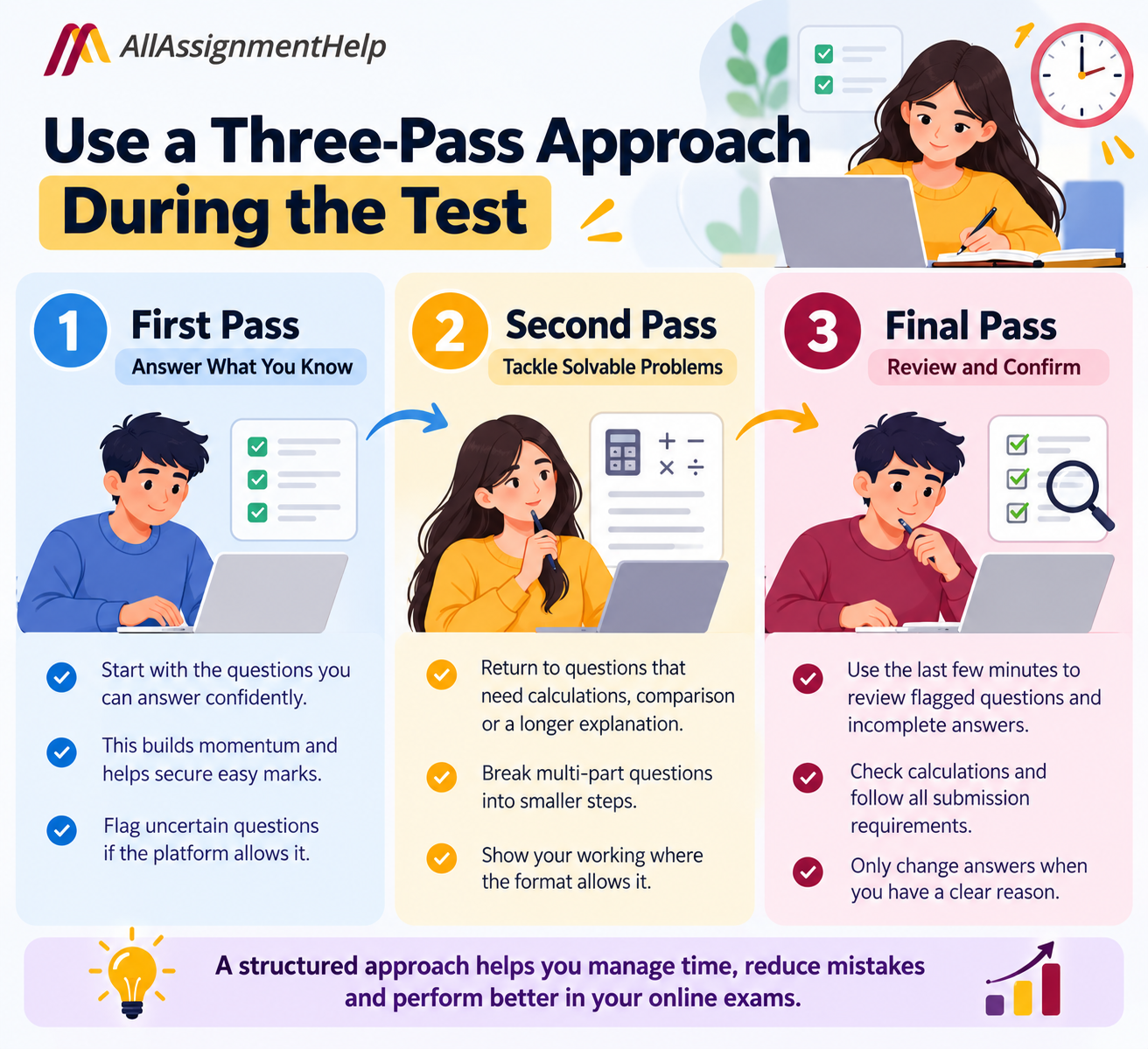
First pass: secure the answers you know
Begin with questions you can answer confidently. This builds momentum and protects marks that should not be sacrificed to one difficult item. Flag uncertain questions if the platform permits it.
Second pass: work through solvable problems
Return to questions that require calculations, comparison or a longer explanation. Break multi-part questions into smaller requirements and show the working where the format allows it.
Final pass: review uncertainty, not everything
Use the final minutes to revisit flagged answers, incomplete calculations and submission requirements. Constantly changing correct answers because they “look too easy” can be counterproductive. Make a change when you can identify a concrete reason.
Analyse the result with an error log
After the test, sort every lost mark into an error category. A simple table is enough:
- Knowledge gap: the concept or fact was not understood.
- Retrieval gap: the material was learned but could not be recalled quickly.
- Reading error: a command word, exception or unit was missed.
- Process error: the correct method was known but applied incorrectly.
- Timing error: too much time was spent on one section.
- Technical error: navigation, saving or file submission caused difficulty.
Add the correct answer, the reason for the mistake and one action before the next attempt. “Revise Chapter 4” is vague. “Complete five questions on confidence intervals without notes” is specific and measurable.
Space attempts instead of repeating the same test immediately
Taking the identical test again straight away may measure memory of the answer key. Allow time to correct the underlying gaps, then use a different question set or rearranged version. A practical cycle is test, review, targeted study, delayed retest and final mixed practice.
If one subject is taking substantially longer than planned, academic support should strengthen understanding and preparation rather than replace your participation. Students balancing several modules can review the available online class support options and confirm what assistance complies with their institution’s rules.
Read more: 70 Fresh GCSE Speech Ideas: Standout Topics, Tips, and Examples
A simple seven-day mock-test schedule
- Day 1: take a baseline test under timed conditions.
- Day 2: build the error log and group mistakes by topic.
- Days 3–4: revisit weak concepts and complete short retrieval exercises.
- Day 5: attempt a new mixed set with a slightly tighter time target.
- Day 6: correct remaining gaps and rehearse the technical setup.
- Day 7: complete a final realistic test, then stop heavy revision early enough to rest.
Read the score by topic, timing and confidence
A single percentage hides several different problems. Divide the result by syllabus topic, question format and time spent. A student may understand a topic but lose marks because long calculations consume too much time. Another may finish early yet misread command words such as “compare,” “justify” or “evaluate.” These patterns require different corrections.
Add a confidence mark before checking each answer: certain, uncertain or guessed. A confident wrong answer deserves special attention because it may reveal a misconception rather than a memory lapse. An uncertain correct answer also matters; the knowledge may not be stable enough to retrieve under greater pressure. Over several attempts, compare whether confidence and accuracy begin to align.
For written responses, do not review only the final conclusion. Check whether the answer addressed every part of the prompt, used relevant evidence and allocated space according to the marks available. For quantitative subjects, identify the first incorrect step rather than treating the entire solution as one mistake. This diagnostic approach turns the mock test into a guide for the next study session.
Frequently asked questions
How many mock tests should I take?
There is no universal number. Continue while each attempt produces useful corrections. Two carefully reviewed tests can be more valuable than six rushed attempts with no error analysis.
Should an online mock test be open book?
Match the real assessment. If the examination is closed book, practise retrieval without notes. If it is open book, practise locating permitted information quickly rather than reading materials for the first time during the test.
What if my mock-test score becomes worse?
Check whether the second test was harder and compare error types, not only percentages. A lower score may still reveal progress if fewer mistakes came from core knowledge and more came from a small number of correctable issues.
Final thought
A mock test becomes valuable when it changes the next study session. Recreate the real conditions, record why marks were lost and convert each error into a small, testable action. That process builds familiarity, improves recall and makes exam preparation far more deliberate.
What this article covers
This guide covers independent mock-test preparation, timing, error analysis and revision planning for online exams. It does not replace official exam instructions, subject teaching, approved accommodations or advice from an instructor.
Terms used in this guide
- Retrieval practice
- Recalling information from memory without first looking at the answer.
- Mock test
- A practice assessment designed to resemble the format or conditions of a real examination.
- Error log
- A record of mistakes, their causes and the actions needed to correct them.
- Open-book exam
- An assessment that expressly permits specified reference materials.
Sources consulted for this guide
- Organizing Instruction and Study to Improve Student LearningInstitute of Education Sciences · Accessed October 17, 2026
- Does Providing Prompts During Retrieval Practice Improve Learning?Institute of Education Sciences · Accessed October 17, 2026

Vyad
- Edited by
- Vyad
- Fact-checked by
- AllAssignmentHelp
- Fact-checked
- July 15, 2027
- Next review
- July 8, 2027
Connect the explanation to the work your course actually requires
Use this guide beside the exact brief, course material and marking criteria for Strategies to Perform Well in Your Online Mock Tests.
- Read the complete brief.
- Identify the expected academic output.
- Follow the marking criteria and source rules.
- Check the final structure and referencing.
Sant Tomas
Accounting
Accounting tutor with experience as a college finance professor and virtual accounting instructor.
View established tutor profile ↗Relevant subject areas
- Accounting
- Finance
- Online Instruction
Find another explanation across the complete blog
This search uses WordPress itself, so it can reach articles beyond the 20 shown on the dashboard.
Connect Strategies to Perform Well in Your Online Mock Tests to the task in front of you
Keep the brief, marking criteria, required evidence and submission format visible while you work.