How Online Class Help Helps Students Succeed in Online Learning

What this article will help you understand
Online class help improves academic performance, time management, and subject understanding through personalized guidance and practical resources. It reduces academic stress, strengthens study habits, and helps students prepare for assignments and exams while building confidence and independent learning skills.
- Online learning requires effective time management, self-discipline, and consistent effort.
- Setting clear goals and following a structured study schedule can improve academic performance.
- Practical examples and interactive tools make complex subjects easier to understand.
- Seeking academic support early can help students overcome learning challenges and reduce stress.
What are you trying to do with this topic?
Choose the closest task and the page will point you towards a useful next step.
Start with the central concept and the terminology used in the article.
Open the closest route ↗Connect the explanation to the question, learning outcomes and marking criteria.
Open the closest route ↗Review evidence, structure, referencing and the exact submission requirements.
Open the closest route ↗Do you have enough information to begin?
Select what you already have. Nothing is submitted from this checklist.
When these details are together, the requirement can be reviewed in context.
Online Class Help ↗Table of Contents
Online learning offers flexibility, convenience, and access to educational resources from almost anywhere. Students can attend virtual lectures, review recorded lessons, and complete coursework without traveling to a physical campus. However, managing multiple assignments, understanding difficult subjects, and staying motivated can be challenging.
This is where online class help can make a difference. The right academic support helps students organize their schedules, understand complex concepts, prepare for examinations, and develop better study habits.
Whether you are pursuing a college degree, completing a professional certification, or taking individual online courses, the goal is to make learning more manageable without compromising educational quality.
In this guide by AllAssignmentHelp, we explore the benefits of academic support, useful digital tools, effective study strategies, and practical ways to improve your online learning experience.
What Is Online Class Help, and Why Does It Matter?
Online class help refers to educational guidance and resources that help students overcome academic challenges. The support can range from tutoring and assignment guidance to study planning and technical assistance.
Unlike traditional classrooms, online courses often require students to manage their learning independently. They must keep track of deadlines, follow course instructions, participate in discussions, and prepare for examinations. However, balancing these responsibilities can become overwhelming, especially when students have to manage work, family commitments, and multiple courses simultaneously. As a result, some students begin searching for solutions to ease their academic workload, using queries like “Can I pay someone to take my class for me?” in the hope of finding support, reducing stress, and keeping up with their coursework.
Common Types of Online Academic Support
Students can explore different forms of assistance depending on their needs:
- Subject tutoring: Understand difficult concepts through personalized explanations and practice exercises.
- Assignment guidance: Learn how to interpret instructions, organize arguments, and improve written work.
- Study planning: Create realistic schedules for lectures, revision, and coursework.
- Exam preparation: Review important topics, solve practice questions, and identify knowledge gaps.
- Technical assistance: Resolve problems involving learning platforms, video lectures, or online submissions.
Why Does Academic Support Matter?
The right guidance can help students identify their weaknesses and develop practical solutions. For example, a student struggling with accounting may benefit from worked examples, while someone missing deadlines may need a structured weekly schedule.
The objective is to make learning more effective while helping students become confident and independent learners.
Also Read: How to Perform Well in Your Online Statistics Class
How Can Online Class Help Improve Academic Performance?
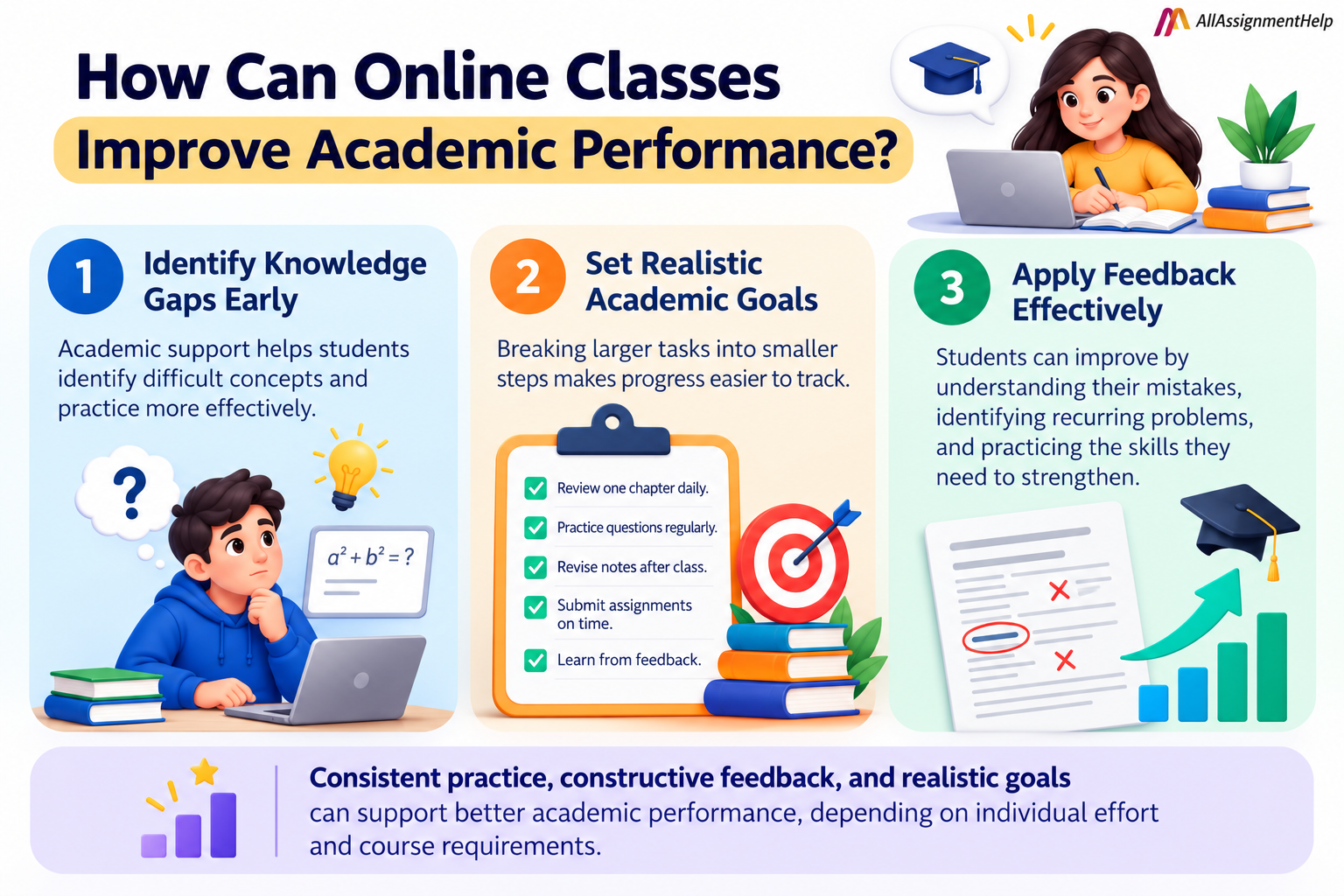
Academic performance depends on subject knowledge, preparation, time management, and the ability to apply information. Educational support can strengthen these areas by helping students identify gaps in their understanding and practice more effectively.
Identify Knowledge Gaps Early
Students sometimes perform poorly despite attending lectures and reviewing their notes. The problem may be an unclear concept, ineffective revision, or insufficient practice.
Academic guidance can help students identify these issues before they affect future coursework.
For example, a tutor can help a statistics student understand why a particular calculation is incorrect and demonstrate the steps needed to solve similar problems.
Set Realistic Academic Goals
Breaking larger objectives into smaller tasks makes progress easier to track.
Students can:
- Review one difficult chapter each day.
- Complete a set number of practice questions.
- Revise lecture notes after class.
- Submit assignments before the deadline.
- Review feedback and correct recurring mistakes.
These small actions encourage consistency and make academic progress more manageable.
Apply Feedback Effectively
Feedback becomes valuable when students understand how to use it. Instead of correcting only the mistakes highlighted by an instructor, learners should identify patterns and work on improving them.
Consistent practice, constructive feedback, and realistic goals can contribute to better academic performance, although results depend on individual effort and course requirements.
How Does Online Class Help Make Time Management Easier?
Managing several courses at once can be difficult, particularly when students also have jobs, family responsibilities, or other commitments.
A structured routine helps prevent deadlines from accumulating and reduces the need for last-minute preparation.
Create a Weekly Study Schedule
Start by listing all your academic responsibilities for the week.
Include:
- Live lectures and recorded lessons.
- Assignment submission dates.
- Quizzes and examination schedules.
- Reading and research tasks.
- Revision sessions and practice exercises.
Assign specific time slots to each task. For example, you might use weekday evenings for lectures and short assignments while reserving part of the weekend for revision.
Break Large Assignments Into Smaller Tasks
A major project can feel overwhelming when viewed as a single activity. Dividing it into manageable steps makes it easier to begin.
For a research assignment, the process might include:
- Understanding the assignment requirements.
- Selecting a suitable topic.
- Finding credible academic sources.
- Preparing an outline.
- Writing and revising the draft.
- Checking citations and submission requirements.
Use Digital Planning Tools
Applications such as Google Calendar and Todoist can help students manage deadlines and reminders.
Choose tools that are simple enough to maintain consistently. A realistic schedule with a few essential reminders is often more useful than a complicated system that becomes difficult to follow.
Also Read: How to Manage Online Classes Effectively: Tips for Students
Can Online Class Help Make Difficult Subjects Easier to Understand?
Yes. Academic support gives students additional opportunities to revisit difficult concepts, ask questions, and practice unfamiliar skills.
This can be especially helpful when lectures move quickly or recorded lessons do not provide enough examples.
Learn Through Practical Examples
Practical examples connect abstract concepts with real situations.
For instance:
- Statistics: Statistics is a challenging subject for many students. When concepts such as probability and standard deviation become difficult to understand, students may feel overwhelmed and wonder, “Why did I enroll in this course?” or “How can I pay someone to take my stat class for me?”. With online class help, students get the opportunity to work through sample datasets to understand averages, probability, and standard deviation.
- Programming: Examine coding errors to understand why a solution fails.
- Biology: Use diagrams to understand cellular processes and biological systems.
- Accounting: Practice preparing financial statements and interpreting transactions.
These activities help students move beyond memorizing definitions and develop a deeper understanding of the subject.
Learn at Your Own Pace
Students do not always understand a topic after one explanation. Additional guidance allows them to revisit difficult areas without feeling pressured to keep pace with an entire class.
They can ask follow-up questions, review worked examples, and practice similar problems until they feel more comfortable applying the concepts independently.
Focus on Understanding, Not Memorization
A useful learning approach explains both the answer and the reasoning behind it.
When students understand why a method works, they are better prepared to apply it to unfamiliar questions and future coursework.
How Can Online Class Help Build Better Study Habits?
Effective study habits make learning more consistent and reduce dependence on last-minute revision.
However, spending more time studying does not always mean learning more. Students also need to choose techniques that encourage understanding and retention.
Use Active Recall
Active recall involves retrieving information from memory instead of simply rereading it.
Students can practice by:
- Answering questions without checking their notes.
- Summarizing a lecture in their own words.
- Explaining a concept aloud.
- Creating flashcards for important definitions.
- Completing practice tests.
Afterward, compare the answers with your study materials to identify areas that need further review.
Apply Spaced Repetition
Rather than reviewing a topic only once, revisit it at regular intervals.
For example, review a lesson on the day you learn it, return to it two days later, and test your understanding again the following week.
This approach encourages repeated retrieval and can help students retain information over time.
Track Your Progress
At the end of each week, review your study routine.
Ask yourself:
- Which topics did I understand well?
- Which concepts still need attention?
- Did I complete my planned study sessions?
- Which distractions affected my concentration?
- What should I change next week?
These simple questions help students develop a more purposeful approach to learning.
How Does Online Class Help Reduce Academic Stress?
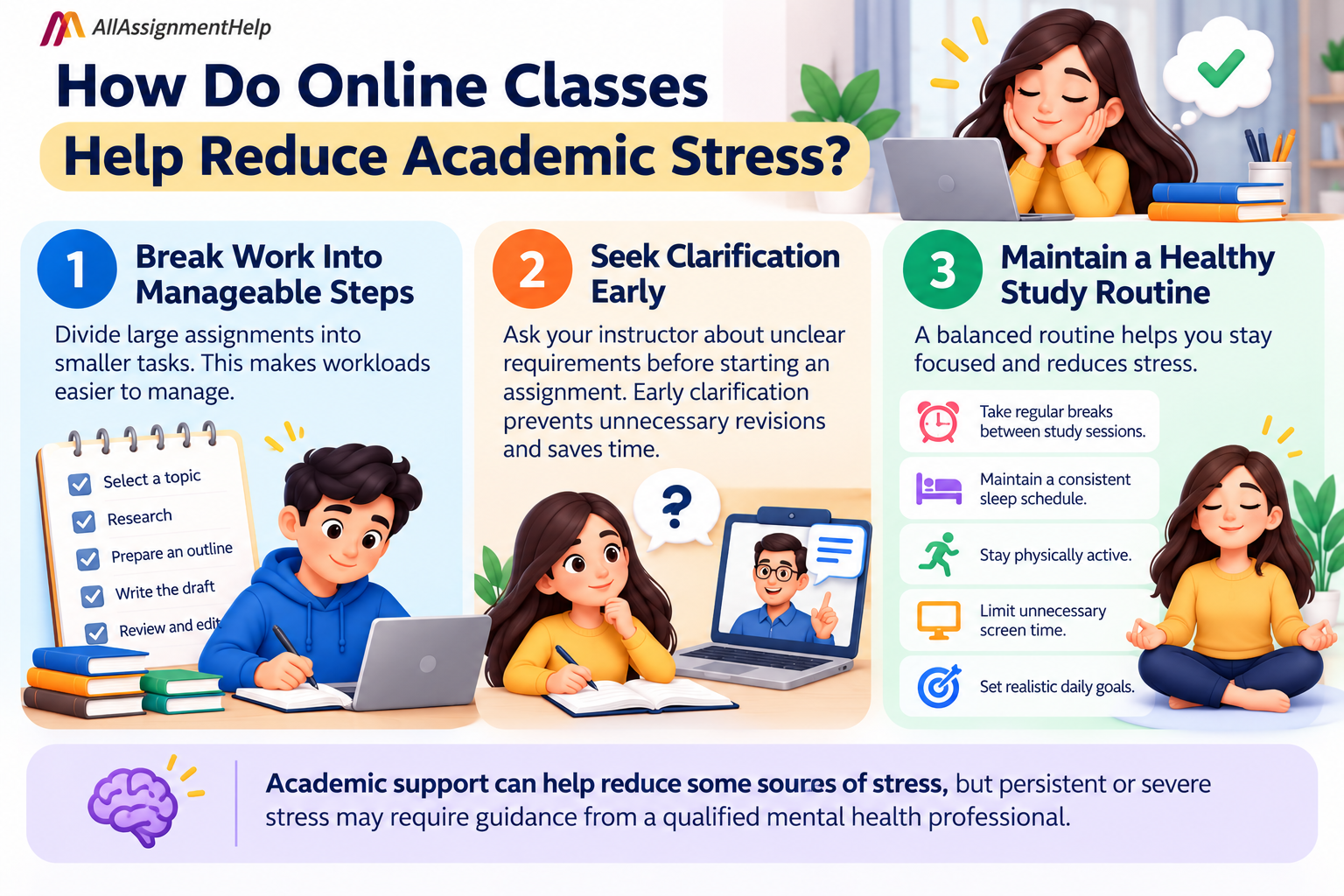
Academic stress can increase when students face several deadlines, difficult subjects, and competing responsibilities. Unclear instructions and poor planning can make the situation even more challenging.
Academic support can help students address practical problems before they become overwhelming.
Break Work Into Manageable Steps
Instead of worrying about an entire research paper, divide it into smaller tasks, such as selecting a topic, gathering evidence, preparing an outline, and reviewing the final draft.
Completing these tasks one at a time makes the workload easier to manage.
Seek Clarification Early
If you do not understand an assignment requirement, contact your instructor before beginning the work.
Early clarification can prevent unnecessary revisions and help you focus on what the assessment actually requires.
Maintain a Healthy Study Routine
Students should make time for rest alongside their academic responsibilities.
Helpful habits include:
- Taking short breaks between study sessions.
- Maintaining a consistent sleep schedule.
- Staying physically active.
- Reducing unnecessary screen time.
- Setting realistic daily goals.
Academic assistance can reduce some sources of pressure, but persistent or severe distress may require support from a qualified mental health professional.
Which Digital Tools Can Improve the Online Learning Experience?
Digital tools can help students organize coursework, research topics, take notes, and practice difficult concepts. The best approach is to choose a few reliable resources that address specific learning needs.
Learning Management Systems
Platforms such as Canvas, Moodle, and Blackboard help students access course materials and manage academic activities.
Students should regularly check these platforms for:
- Lecture notes and recorded lessons.
- Assignment instructions and deadlines.
- Instructor announcements.
- Grades and feedback.
- Discussion forums and course updates.
Digital Calendars and Task Managers
Google Calendar and Todoist can help learners organize deadlines and schedule study sessions.
Students can set reminders, divide projects into smaller tasks, and prioritize important work.
Digital Note-Taking Applications
Microsoft OneNote and Evernote can help students organize notes, reading materials, and revision summaries.
Using consistent headings, folders, and file names makes information easier to find during examinations.
Academic Research and Practice Tools
Students can explore resources such as:
- Google Scholar: Find scholarly articles and academic publications.
- University library databases: Access research papers, books, and other credible sources.
- Khan Academy: Review educational concepts through lessons and practice exercises.
- PhET: Explore interactive science and mathematics simulations.
Always check whether a source is suitable for your assignment and verify important information against credible academic materials.
How Can Online Class Help Strengthen Assignment and Exam Preparation?
Assignments and examinations often require students to analyze information, apply concepts, solve problems, and communicate their reasoning clearly.
A structured preparation strategy helps learners understand expectations and identify areas that need improvement.
Understand Assignment Requirements
Before starting an assignment, read the instructions carefully and identify the main task.
Pay attention to words such as analyze, compare, evaluate, and explain. Each word indicates a different type of response.
Students should also review the grading rubric to understand how marks are distributed across research, argument quality, accuracy, organization, and referencing.
Prepare for Examinations Strategically
Effective exam preparation involves more than reading notes repeatedly.
Students can:
- Review the course learning objectives.
- Identify frequently misunderstood concepts.
- Complete practice questions.
- Review incorrect answers.
- Create short revision summaries.
- Practice answering questions within a time limit.
Learn From Mistakes
Mistakes can reveal gaps in understanding and highlight where additional practice is needed.
For example, if a student repeatedly loses marks because of incorrect calculations, they should revisit the underlying method and practice similar questions before the examination.
Students can seek explanations and feedback while completing assessed work themselves and following their institution’s academic integrity rules.
How Can Students Choose the Right Online Academic Support?
Different challenges require different solutions. A student struggling with accounting concepts and wondering, “Can someone take my accounting class for me?” may benefit from subject-specific tutoring and additional practice. In contrast, a student who frequently misses deadlines may need better time-management strategies, a structured study schedule, and help prioritizing academic tasks.
Choosing appropriate support starts with understanding the problem.
Identify Your Main Learning Challenge
Consider which area needs the most attention:
- Subject knowledge: Look for qualified tutors or additional learning resources.
- Writing skills: Use writing centers or feedback services to improve structure and clarity.
- Time management: Explore planners, calendars, and accountability techniques.
- Technical difficulties: Contact the institution’s technical support team.
- Research skills: Seek guidance from librarians or academic instructors.
Evaluate Quality and Reliability
Before choosing a paid service, consider its qualifications, pricing, privacy practices, and terms of service.
Avoid providers that guarantee specific grades, make unrealistic promises, or request unnecessary access to your academic accounts.
Explore Free Resources First
Many colleges and universities offer useful support without additional fees.
Check whether your institution provides:
- Academic tutoring.
- Writing centers.
- Instructor office hours.
- Peer study groups.
- Library research assistance.
- Technical support.
The most appropriate option is one that addresses your needs and helps you build skills for future academic challenges.
How Can Online Class Help Encourage Independent Learning?
Independent learning means taking responsibility for understanding course material, identifying weaknesses, and finding effective ways to improve.
Academic guidance can support this process without replacing the student’s own effort.
Apply Feedback to Future Tasks
When an instructor identifies weaknesses in an essay, use the feedback to improve future assignments.
For example, if your arguments lack supporting evidence, focus on finding credible sources and explaining how each source supports your main point.
Develop Problem-Solving Skills
Students should try to solve problems independently before seeking an explanation.
If they get stuck, they can review the relevant lesson, consult a reliable resource, or ask a tutor for guidance.
After receiving help, they should attempt a similar problem without assistance to check their understanding.
Reflect on Your Learning Progress
A short weekly review can help students identify what is working and what needs to change.
Record completed tasks, challenging topics, and goals for the following week. Over time, this habit can improve self-awareness and make study routines more effective.
The objective is to use support as a learning opportunity and gradually become more confident in handling academic responsibilities independently.
What Common Mistakes Should Students Avoid When Seeking Online Class Help?
Academic support is most effective when students use it to improve their knowledge and skills. Certain mistakes can limit its benefits.
Waiting Until the Last Minute
Leaving questions or assignments until the deadline approaches limits the time available for clarification and revision.
Start early whenever possible and seek help as soon as you identify a problem.
Relying on Answers Without Understanding Them
Copying solutions may help complete an immediate task, but it does not build the skills required for future assessments.
Focus on understanding explanations, practicing similar questions, and completing graded work according to institutional rules.
Using Unreliable Resources
Incorrect information can lead to misunderstandings and poor assignment quality.
Verify important claims against course materials, academic publications, and other credible sources.
Ignoring Personal Study Habits
Even high-quality support cannot replace consistent effort.
Students should attend lectures, complete practice exercises, review feedback, and maintain a realistic study schedule.
Overlooking Privacy and Academic Integrity
Do not share passwords or examination credentials with unverified providers. Check your institution’s rules before using outside assistance or artificial intelligence tools for assessed work.
Conclusion
Online education provides flexibility, but students still need effective strategies to manage coursework, understand difficult subjects, and prepare for assessments.
The right online class help can make these responsibilities more manageable through tutoring, study planning, digital tools, constructive feedback, and practical learning strategies.
To make the most of available support:
- Identify your biggest academic challenge.
- Set realistic learning goals.
- Create a manageable weekly schedule.
- Practice difficult concepts regularly.
- Seek feedback before deadlines approach.
- Use support to develop independent learning skills.
Ultimately, a successful online learning experience is about more than completing assignments on time. It involves developing knowledge, improving confidence, and building habits that support long-term academic growth.
Frequently Asked Questions
1. What is online class help?
Online class help includes academic resources and guidance that support students with coursework, subject understanding, exam preparation, and study planning. Examples include tutoring, instructor feedback, writing guidance, and digital learning tools.
2. Can online class help improve my grades?
Academic support can help students understand difficult concepts, correct mistakes, and prepare more effectively for assessments. However, results depend on individual effort, course requirements, and how consistently students apply what they learn.
3. Is online academic support suitable for college students?
Yes. College students often manage several courses, research projects, and examinations simultaneously. Appropriate academic support can help them organize their workload, strengthen subject knowledge, and develop effective study habits.
4. How can I manage multiple online classes without feeling overwhelmed?
Create a weekly schedule that includes lectures, assignment deadlines, revision, and breaks. Divide large projects into smaller tasks and prioritize work according to deadlines and difficulty to keep your workload manageable.
5. Which tools are useful for online learning?
Learning platforms such as Canvas and Moodle help students access course materials, while digital calendars and note-taking applications support organization. Google Scholar, Khan Academy, and PhET can also help with research and subject practice.
6. Can online tutoring help me understand difficult subjects?
Online tutoring provides personalized explanations, practical examples, and opportunities to ask questions. It can help students understand unfamiliar concepts and develop problem-solving skills through guided practice.
7. How early should I seek help with an assignment?
Seek help as soon as you identify a problem or find the instructions unclear. Starting early gives you enough time to research, develop your ideas, revise your work, and address feedback before the deadline.
8. Is free online class help available?
Yes. Many educational institutions offer free tutoring, writing centers, library resources, instructor office hours, and peer study groups. Educational websites also provide lessons and practice materials, although some features may require payment.
9. How can I stay motivated during online classes?
Set achievable daily goals, follow a regular study schedule, and track your progress. Taking breaks, limiting distractions, and connecting with classmates can also make learning more engaging and sustainable.
10. How can I use online class help responsibly?
Use academic support to improve your understanding, practice skills, and learn from feedback. Follow your institution’s rules on collaboration and outside assistance, and complete assessed work yourself unless a specific form of assistance is explicitly permitted.
What this article covers
This article explores practical strategies to improve the online learning experience, including time management, active learning, goal setting, and academic support. The effectiveness of these strategies may vary depending on a student's learning style, course requirements, available resources, and personal responsibilities. While these approaches can help students manage coursework more effectively, they do not guarantee specific grades or academic outcomes.
Terms used in this guide
- Online Learning: Education delivered through digital platforms and virtual classrooms.
- Online Class Help: Academic guidance and resources that help students understand course materials and manage coursework.
- Time Management: Planning and organizing study time to complete academic tasks efficiently.
- Active Learning: Engaging with course materials through practice, problem-solving, discussions, and real-world examples.
- Academic Performance: A student's progress and achievement based on assessments, assignments, participation, and other course requirements.
- Self-Discipline: The ability to stay focused, follow a study routine, and complete coursework independently.
- Academic Support: Resources such as tutoring, instructor feedback, study groups, and learning tools that help students overcome academic challenges.
Sources consulted for this guide
- U.S. Department of EducationU.S. Department of Education · Accessed October 28, 2026
- National Center for Education StatisticsNational Center for Education Statistics · Accessed October 28, 2026
- EDUCAUSEEDUCAUSE · Accessed October 28, 2026
- Online Learning ConsortiumOnline Learning Consortium · Accessed October 28, 2026
- CASTCAST · Accessed October 28, 2026

Vyad
- Fact-checked by
- Vyad
What changed: The article’s quality improved through clearer explanations, practical examples, actionable learning strategies, and better topic coverage. It provides more useful insights into academic support, time management, study habits, and exam preparation while maintaining a conversational tone and reader-friendly structure.
Connect the explanation to the work your course actually requires
Use this guide beside the exact brief, course material and marking criteria for Online Class Help.
- Name the course and current module.
- Include the platform instructions.
- Follow the instructor's method.
- Use the exact local deadline and time zone.
Raul Hegidges
Psychology · 4.8/5
Raul’s published profile combines psychology writing experience with cognitive science, quantitative research and clinical reasoning. Master’s in Psychology, University of Queensland
View established tutor profile ↗Relevant subject areas
- Psychology and Cognitive Science
- Numeracy and Quantitative Research
- Clinical Reasoning
- Experiential Learning
Find another explanation across the complete blog
This search uses WordPress itself, so it can reach articles beyond the 20 shown on the dashboard.
Connect Online Class Help to the task in front of you
Keep the brief, marking criteria, required evidence and submission format visible while you work.