
Table of Contents
For many aspiring nurses, online nursing programs have made higher education more accessible than ever. They allow students to balance coursework with jobs, family responsibilities, and clinical commitments. However, flexibility does not mean online nursing classes are easier. Accredited online nursing programs typically follow the same academic standards as traditional classroom programs, including challenging exams, clinical placements, virtual simulations, research assignments, and strict deadlines.
Success in an online nursing program requires more than simply attending virtual lectures. It demands strong time management, self-discipline, active participation, and practical learning habits. Research on online nursing education shows that students perform better when they follow structured study routines, stay engaged with instructors, and participate in collaborative learning activities.
Whether you’re already enrolled or planning to begin your nursing journey, building the right habits early can make your coursework more manageable and help prepare you for real-world patient care.
In this blog, created by the experts at AllAssignmentHelp , we’ll discuss the top ten effective strategies for success in online nursing classes. If you’re pursuing online nursing courses or planning to enroll in one, these practical tips can help you stay organized, improve your performance, and confidently progress toward graduation.
So, let’s get started
Quick Tips for Success in Online Nursing Classes
- Create a weekly study schedule.
- Study in a distraction-free environment.
- Stay active in discussion boards.
- Review instructor feedback after every assignment.
- Apply nursing concepts through case studies instead of memorizing.
- Track every assignment and exam deadline.
- Ask for academic support before falling behind.
Top 10 Tactics for Succeeding in Online Nursing Classes
Online nursing education continues to grow because it offers greater accessibility for students with different schedules and responsibilities. While many institutions now offer flexible learning options, success still depends on maintaining consistency, organization, and active engagement throughout the course.
Here are the strategies that can help you perform better academically while preparing for your future nursing career.
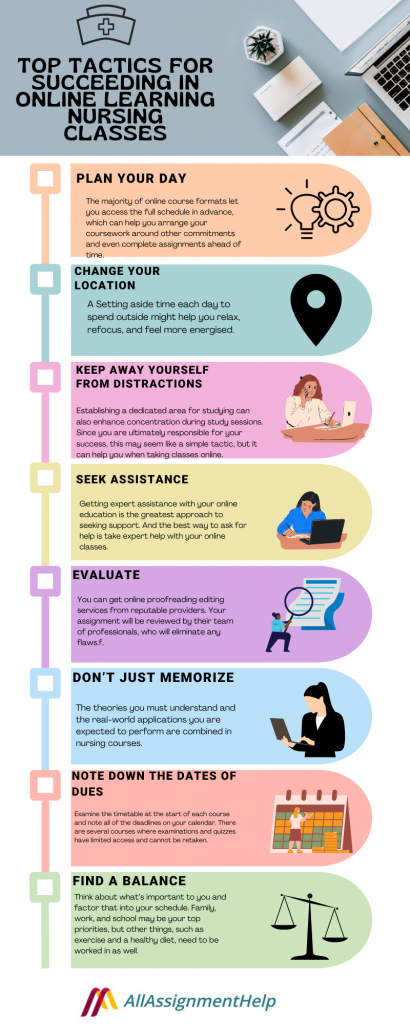
1. Make a Detailed Plan for Every Day
The flexibility of online learning is one of its biggest advantages, but it can also become its biggest challenge if you don’t have a routine.
Instead of deciding what to study each day, create a structured weekly plan before the week begins.
Include time for:
- Watching recorded lectures
- Reading textbook chapters
- Completing assignments
- Reviewing previous notes
- Practicing quizzes
- Preparing for clinical work
Most online nursing platforms publish the course schedule in advance, allowing you to organize your workload around work shifts, family responsibilities, or personal commitments.
Unlike traditional classrooms that require you to remain on campus throughout the day, online coursework services can be accessed from almost anywhere, making planning even more important.
Pro Tip: Use Google Calendar or your LMS calendar to set reminders 2–3 days before every major deadline.
2. Change Your Study Location When Needed
One challenge many online learners face is isolation and reduced motivation after studying in the same place every day.
Changing your environment occasionally can refresh your focus and improve productivity.
Consider studying in:
- Your local library
- A quiet coffee shop
- A campus study room
- A peaceful outdoor space with internet access
A short walk before studying can also help reduce mental fatigue and improve concentration.
However, don’t change locations too frequently. Having one primary study space helps your brain associate that environment with learning while occasional changes can prevent burnout.
Keep Yourself Away From Distractions
A dedicated study environment can significantly improve concentration.
Choose a place where you can keep your:
- Laptop
- Textbooks
- Nursing notes
- Calculator
- Highlighters
- Clinical reference materials
Before beginning a study session:
- Put your phone on silent.
- Close unnecessary browser tabs.
- Turn off social media notifications.
- Inform family members about your study hours.
Creating this habit makes it easier to enter “study mode” every time you sit down.
Read More: Time Management Hacks for Busy Online Nursing Students
Seek Assistance
Many students assume that online classes mean learning independently, but that’s far from reality.
Your instructors remain one of your most valuable resources.
Most nursing educators offer:
- Email support
- Virtual office hours
- Discussion forums
- Video meetings
Research on online nursing education highlights that instructor presence and timely communication improve student engagement and learning outcomes.
Whenever you’re struggling with:
- Dosage calculations
- Care plans
- Medical terminology
- Research assignments
Ask questions as early as possible instead of waiting until deadlines approach. Sometimes students need additional guidance beyond classroom support. In such situations, you can seek academic guidance from experienced professionals who can help explain concepts, organize coursework, and improve understanding.
If you’re overwhelmed by multiple responsibilities and wondering can someone take my online class for me? Then you can explore support services where experts provide academic guidance and support.
Evaluate the Writing You’ve Done
Writing plays a major role in nursing education.
Students regularly complete:
- Case studies
- Research papers
- Care plans
- Reflective journals
- Evidence-based practice assignments
Before submitting any assignment:
- Proofread carefully.
- Check grammar and spelling.
- Follow APA formatting.
- Compare your work with the grading rubric.
Many colleges also provide online writing centers that can help improve academic writing skills.
Furthermore, If you’re not confident about your final draft, you can also use online proofreading editing services to review grammar, clarity, formatting, and overall presentation before submission.
6. Apply What You’ve Learned Instead of Memorizing
One of the biggest mistakes nursing students make is trying to memorize everything.
Nursing is a practical profession.
Instead of asking:
“What is this definition?”
Ask:
“How would I use this while caring for a patient?”
Research shows that active learning methods, including case-based learning, practice quizzes, and simulation, improve understanding and knowledge retention.
Ways to practice include:
- Patient case studies
- Medication calculation exercises
- Virtual simulation labs
- Clinical scenario discussions
One useful resource that supports practical learning is Simulator Labs, which helps bridge the gap between theoretical knowledge and clinical application.
7. Write Down Every Important Deadline
Missing deadlines can seriously affect your grades.
Some nursing courses include:
- Timed quizzes
- Locked examinations
- Weekly discussion posts
- Clinical documentation
Many of these cannot be reopened after the deadline passes.
At the beginning of every semester:
- Record every due date.
- Set reminder alerts.
- Break larger assignments into smaller weekly goals.
This approach reduces last-minute stress while helping you stay ahead of your coursework.
8. Find a Healthy Balance Between School and Life
Many online nursing students work full-time while studying.
Without balance, burnout becomes a real risk.
Protect your energy by prioritizing:
- 7–8 hours of sleep
- Healthy meals
- Regular physical activity
- Scheduled breaks
- Time with family
Even short breaks improve concentration and reduce mental fatigue during long study sessions.
9. Participate in Forums and Study Groups
Learning becomes stronger when you discuss concepts with others.
Online nursing programs usually include:
- Discussion boards
- Group projects
- Peer reviews
- Virtual study sessions
Participating actively helps you:
- Clarify difficult concepts
- Improve critical thinking
- Strengthen communication skills
- Learn different approaches to patient care
Research supports collaborative learning as an effective strategy for improving engagement and clinical reasoning among nursing students.
10. Make the Most of Instructor Feedback
Every assignment contains valuable learning opportunities.
After receiving your grades:
- Read every comment carefully.
- Identify recurring mistakes.
- Apply those improvements to future assignments.
Students who actively use instructor feedback often improve both their writing quality and clinical reasoning throughout their program.
As nursing courses become more advanced, expectations for academic writing and evidence-based reasoning also increase, making early improvements especially valuable.
Common Mistakes That Hold Nursing Students Back
Avoiding these common mistakes can improve your chances of succeeding in online nursing classes.
- Waiting until the weekend to study.
- Ignoring discussion boards.
- Missing quiz deadlines.
- Memorizing instead of understanding concepts.
- Avoiding communication with instructors.
- Studying in distracting environments.
- Skipping self-care during busy weeks.
Recognizing these habits early can help you build a more consistent learning routine.
Wrap Up
Success in online nursing classes doesn’t happen because students study longer, it happens because they study smarter.
A structured schedule, an organized study space, active participation, and practical learning strategies can help you manage challenging coursework while preparing for clinical practice. Online nursing programs provide flexibility, but they also require accountability and consistent effort.
Be willing to adjust your routine when necessary, seek help before problems grow, and use every resource your institution provides. The skills you build during your online nursing education, critical thinking, communication, organization, and lifelong learning, will continue benefiting you throughout your nursing career.
Read More: Stress Management Tips for Thriving in Online Physics Class
FAQs
What are the different types of nursing degrees available online?
Many colleges and universities offer accredited online nursing programs at different education levels, including:
- Associate Degree in Nursing (ADN)
- Bachelor of Science in Nursing (BSN)
- RN-to-BSN programs
- Master of Science in Nursing (MSN)
- Doctor of Nursing Practice (DNP)
- Postgraduate APRN certificate programs
Before enrolling, always verify that the program is accredited by a recognized nursing accreditation body and meets your state’s licensure requirements.
What courses should I take to become a nurse online?
Most online nursing programs include foundational subjects such as:
- Biology
- Anatomy and Physiology
- Chemistry
- Psychology
- Sociology
- Pharmacology
- Microbiology
- Nursing Fundamentals
Students who succeed in online nursing programs typically have strong time management, organizational skills, and a willingness to seek support whenever needed.